What is Product-Market Fit?

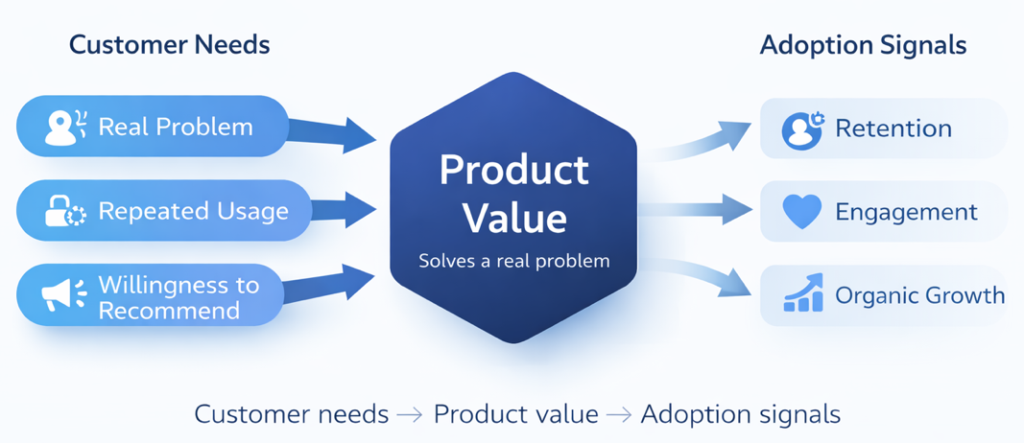
Product–Market Fit (PMF) is the alignment between your product’s value and the real needs of your target market. It means you’ve built something that solves a meaningful problem, and customers adopt it willingly.

You see product–market fit in behaviour, not declarations. Customers come back. They engage without prompting. They recommend the product because it genuinely helps them.

It’s the moment the market pulls your product forward, instead of you pushing it through marketing pressure.

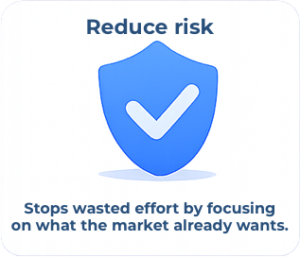
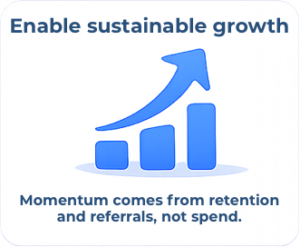
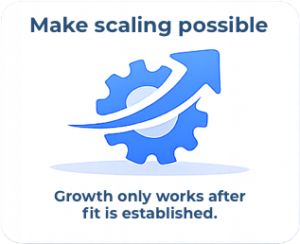
Why Product-Market Fit is Non-Negotiable

How Product-Market Fit Shows Up in the Real World

Product-market fit doesn’t look the same in every category, but it shows up through consistent, observable patterns of behaviour.

Before Product-Market Fit

  • Teams debate opinions instead of reading signals
  • Growth requires constant pressure and spend
  • Messaging keeps changing because nothing quite sticks
  • Roadmaps expand faster than clarity

As Product-Market Fit Emerges

  • Usage stabilizes and repeats without prompting
  • Retention improves before growth accelerates
  • Customer language begins shaping positioning
  • Priorities become easier to agree on

After Product-Market Fit

  • Demand pulls the product forward
  • Referrals appear without incentives
  • Growth compounds instead of stalling
  • Teams spend less time debating and more time executing

Common Product-Market Fit Failure Modes

Most teams don’t fail to find product-market fit because they lack effort or talent. They fail because they misread signals, move too early, or optimize for the wrong things.

The most common failure modes include:

Scaling before demand is proven
Investing in growth, hiring, or marketing before usage and retention are stable.

Confusing engagement with value
Mistaking activity, clicks, or short-term usage for genuine, repeatable value.

Listening to the loudest customers
Over-indexing on edge cases instead of representative users and real buying behaviour.

Treating PMF as a milestone
Declaring fit too early instead of continuously validating it as markets evolve.

Expanding the roadmap instead of narrowing focus
Adding features to compensate for unclear value, rather than sharpening the core.

Using internal conviction to override market evidence
Relying on vision, consensus, or momentum when customer behavior is sending mixed signals.

These patterns are easy to rationalize in the moment, and expensive to unwind later.

The Role of Product-Market Fit in Scaling

Product-market fit doesn’t guarantee growth, but growth without it guarantees waste.

When fit is in place:

  • Marketing amplifies demand instead of forcing it
  • Hiring strengthens execution instead of adding complexity
  • Systems and process scale what’s already working

When fit is missing:

  • Spend increases but results don’t compound
  • Teams grow faster than clarity
  • Small inefficiencies turn into structural problems

Product-market fit is the condition that makes scaling durable, repeatable, and defensible.

How I Help Teams Establish Product-Market Fit

I work with founders and leadership teams at key inflection points in a product’s lifecycle.

My role is to help teams:
Identify which signals actually matter, and which are noise

  • Pressure-test assumptions through direct customer interaction
  • Narrow focus to what creates real, repeatable value
  • Decide when to iterate, when to invest, and when to stop
  • Translate fit into clear direction across product, technology, and delivery

The work isn’t about following a framework.
It’s about making better decisions sooner, with evidence instead of hope.

Start with a product strategy discussion

Clear product decisions don’t come from more process. They come from better judgment, grounded in market reality.

Scroll to Top